5 min read
Why Record a Video Podcast in a Studio Rather Than at Home?
Thinking about recording your video podcast at home? Discover how a professional podcast studio can improve sound, lighting, framing, guest experience and production consistency.
Category:
Podcast
Updated:
Sep 9, 2026


Gauri Khurana
Community Growth Strategist
Why Record a Video Podcast in a Studio Rather Than at Home?
If there's one thing you should know before you start a podcast, it's this: the first episode is always the easiest one.
You pick a room. You buy a mic off a list someone shared on Instagram. You prop your phone against a stack of books, angle a desk lamp at your face, and hit record. It works. Honestly, it works better than you expected — the first time.
The trouble shows up later. Somewhere around episode six, when you've got a guest coming, and the guest has questions you don't have answers to. Where do I sit? Is that a fan I'm hearing? Why does my side of the video look yellow and yours look blue?
That's usually the moment a creator starts typing "podcast studio near me" into Google at 11 pm.
This piece is for that moment. Not to tell you that home recording is wrong — it isn't — but to walk through, honestly, what changes when your podcast stops being a hobby and starts being something people expect to show up on time, looking and sounding like itself. A home setup can help you start a podcast. A professional studio can help you produce one, consistently, episode after episode.
And the timing matters more than it used to. Edison Research's Podcast Consumer 2026 study found that weekly video consumption has now caught up to audio-only listening — a shift that would have sounded far-fetched even two years ago. Viewers aren't just tolerating video podcasts anymore. Increasingly, they're choosing them. Which means the room you record in isn't a backdrop. It's part of the product.
So let's talk about what actually changes between a spare room and a studio — and where, if you're recording in Mumbai, a space like Hot Bun Studios starts to make a lot more sense than another Sunday spent rearranging furniture.
A Home Podcast Setup Is Cheaper Only at First
Here's the quiet lie of home recording: the room is free, so the podcast feels free.
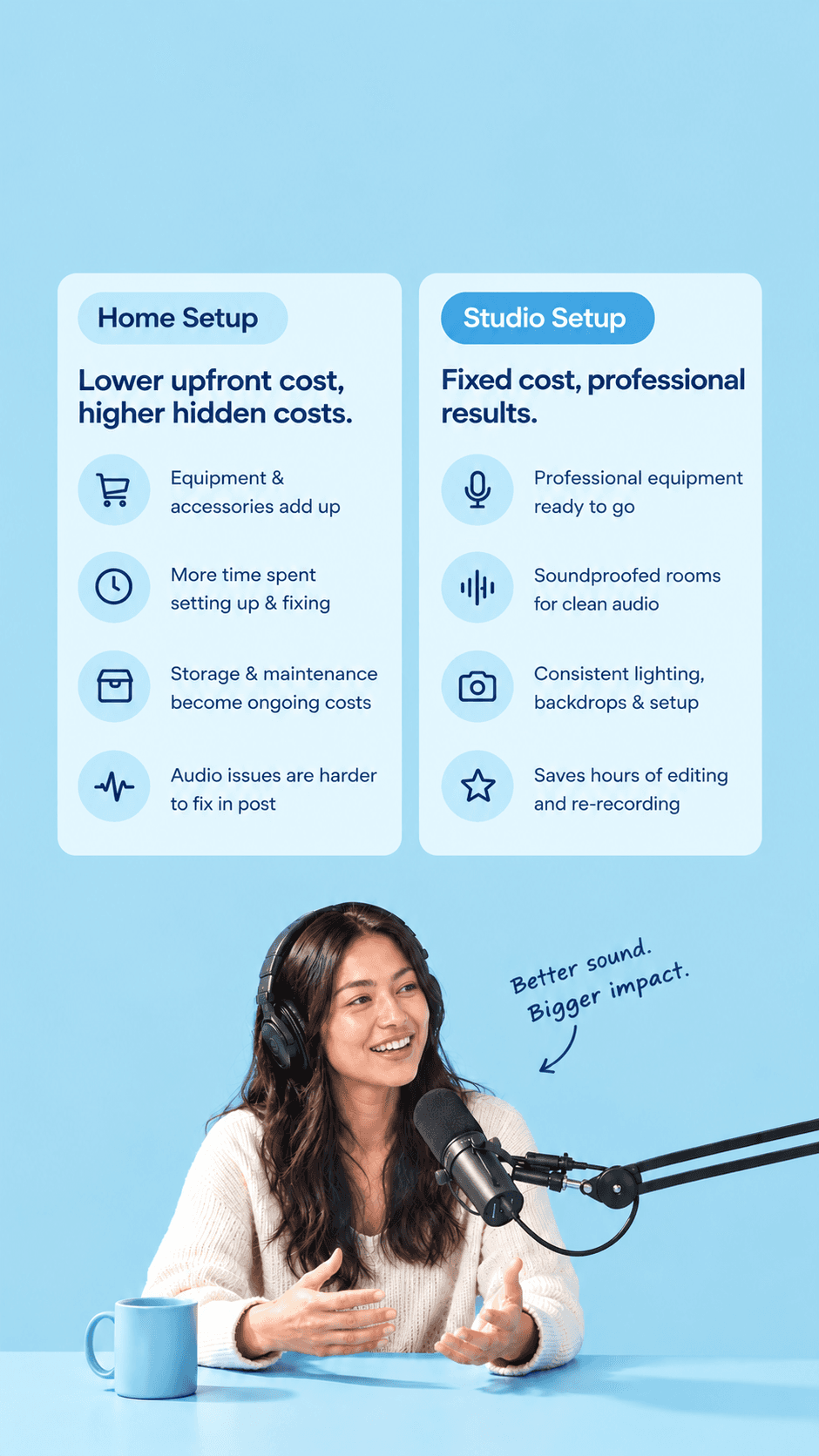
It isn't, though. Not really. What starts as "I already have a room" slowly turns into a shopping list — acoustic panels, a second mic, a mic stand, an audio interface, a decent camera, a couple of lights, a backdrop that doesn't look like a backdrop, extra storage for the footage, and — quietly, in the background — hours spent fixing bad audio in post because it couldn't be fixed on the day.
None of these purchases are wrong on their own. The problem is what they add up to: a creator slowly reconstructing, piece by piece and rupee by rupee, a room that was already built somewhere else.
That's really the trade-off. A studio charges you for time. A home setup charges you in equipment, storage, maintenance, and the hours you'll never get back setting things up and tearing them down. Hot Bun Studios, for what it's worth, keeps this part refreshingly simple — ₹1,500 an hour for the Shoot Studio, ₹2,500 an hour for the acoustically treated Audio Studio, with a 13–30% discount once you cross four hours. No guesswork, no slow equipment graveyard building up in a corner of your bedroom.
Sound Problems Are Harder to See Than Video Problems
You can see a bad shot immediately. Bad audio hides.
The video looks fine on the little camera screen. It's only later, in headphones, during the edit, that you notice the room has a faint echo, or that a fridge somewhere is humming under every sentence, or that your guest's voice sounds different from yours because you're sitting three feet closer to the mic than they are.
Try this, if you haven't: record thirty seconds of silence in the room you're planning to use. Play it back on headphones, then on your phone speaker. Does the room sound present — like a space with walls and hard floors — even when nobody's talking? If yes, that sound will sit under every word of your podcast, and no amount of noise-reduction software will fully erase it. Software can reduce a problem. It can't recreate a room that was never built to be quiet in the first place.
This is where the case for a proper studio gets hard to argue with. A soundproofed room isn't a nice-to-have; it's the difference between spending three hours editing an episode and spending forty minutes on it. Hot Bun Studios runs two separately soundproofed spaces — the shoot area and a dedicated audio room — so what you record doesn't carry the fridge, the traffic outside, or the neighbour's dog into the final cut.
Your Room Becomes Part of Your Brand, Whether You Plan It To or Not
Nobody watches a podcast in a vacuum. Viewers read the room the same way they read a person — instantly, and mostly without meaning to.
A cluttered bookshelf, an awkward gap of wall behind your head, a lamp that's clearly there to hide a stain — none of it is wrong, exactly. But it says something. Usually, it says this wasn't planned. And if your show is trying to look like a serious, brand-friendly, sponsor-ready property, a background that looks improvised works against you before you've said a single word.
This isn't an argument that every podcast needs to look like a television studio. A casual, personal show can lean into a home environment on purpose — that's a choice, and it can work beautifully. The problem only shows up when the ambition of the content and the look of the room don't match.
A space with proper backdrops solves this without much thought on your end. Hot Bun Studios has four roll-down backdrops in different colours plus a green screen, which means you can shift the entire visual identity of an episode — or record three completely different formats in one afternoon — without repainting a wall or buying new furniture.
Why Home Lighting Makes Podcasts Look Flat
Lighting is the part creators underestimate the most, mostly because bad lighting doesn't look bad — it just looks less finished.
Natural light shifts while you're mid-recording. A window behind you turns the background into a white blur. Overhead lights throw shadows under the eyes. Two different bulbs in the same room create two different skin tones on camera, and a lamp that looks warm and cosy to the eye can look muddy and yellow on video.
A podcast needs more than "enough light." It needs a key light on the speaker, a way to separate the person from the background, and colour consistency from the first episode to the fiftieth — otherwise clips start looking like they belong to different shows entirely, and an editor ends up spending hours color-correcting problems that a controlled lighting setup would have prevented on the day.
A Studio Gives You Room to Actually Frame the Shot
Small apartments are, by nature, unkind to camera placement. There's only so far back you can move, only so many angles a single room allows before you're filming the wall.
A one-camera setup pointed at a sofa can carry a short, casual conversation. It starts to feel visually flat over a long episode with two or more people talking, and there's no easy fix for that in a room where there's nowhere else to put a second camera.
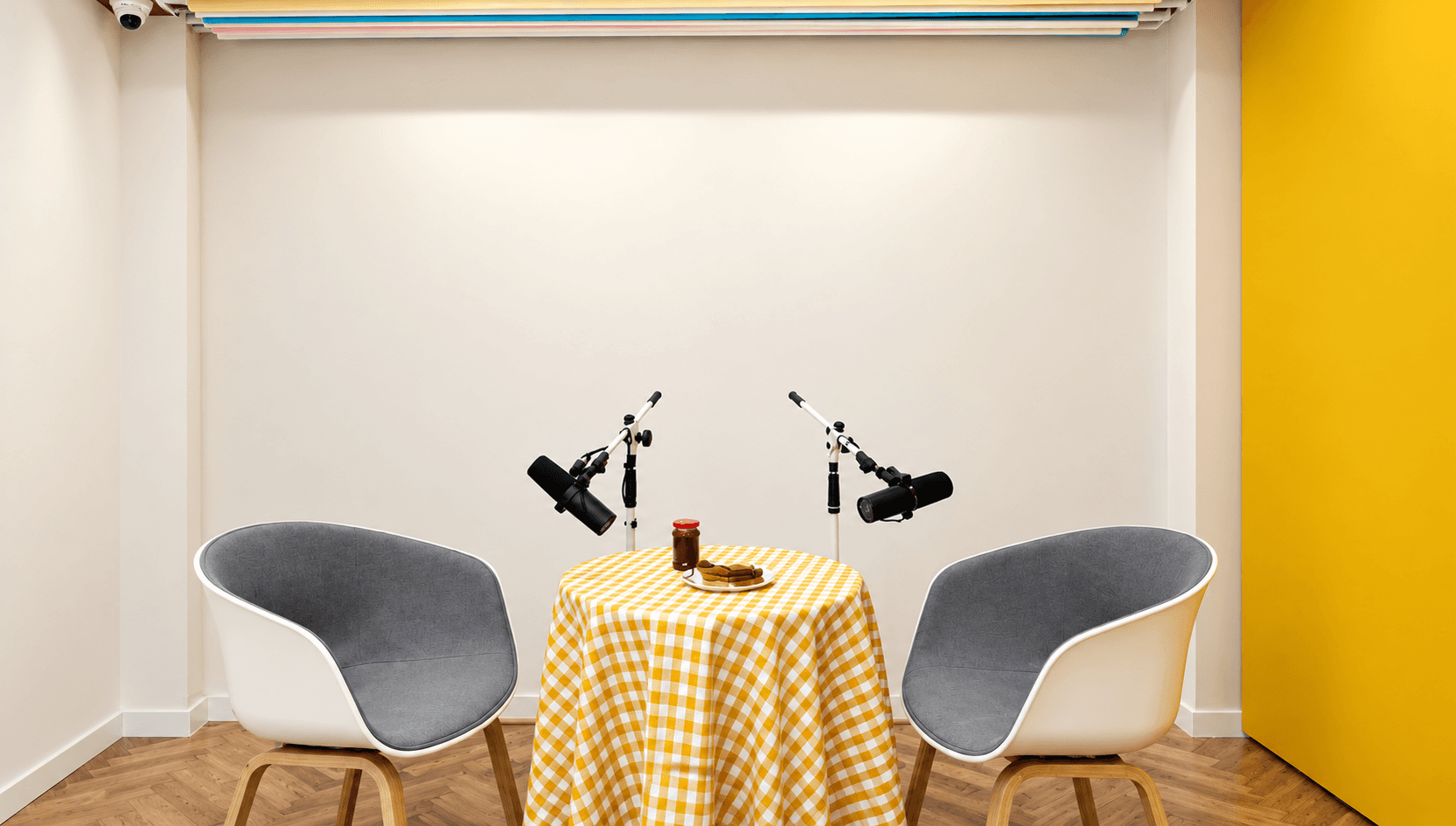
A studio built for this removes the guesswork. In a home setup, the shot is usually built around whatever the room allows. In a proper studio, the same conversation can be covered with a wide shot, a host close-up, a guest close-up, and clean eyelines — all without moving furniture between takes. Hot Bun's podcast setup runs multiple cameras with broadcast-quality mics in an 800+ sq ft layout, which gives an editor real material to cut with instead of one flat angle stretched across forty minutes.
More cameras don't guarantee more views, to be clear. But they give whoever's editing the room to keep a conversation visually alive.
Recording at Home Turns Every Episode Into a Construction Project
Here's the part nobody warns you about: it's not that a home setup can't look good. It's that looking good requires solving the exact same set of problems, from scratch, every single time you record.
Move the furniture. Clear the background. Set the mics. Hide the cables. Adjust the lights. Check the framing. Wait for the traffic outside to quiet down. Test the sound. Then, when it's over, undo all of it so the room can go back to being a bedroom.
Once a week, that's tolerable. As a podcast grows — more guests, more frequency, more pressure to publish on schedule — it becomes the thing that quietly kills the show. Episodes get rushed. Recording days get cancelled. Quality slips just enough that regular viewers notice, even if they can't quite say why.
A studio strips this problem out entirely. Same-day booking works for standard use at Hot Bun Studios, and the space is already lit, backed, and mic'd when you walk in — which means the only thing left to do that day is have the conversation you came to record.
Guest Experience Shapes the Conversation You Actually Get
It's easy to focus entirely on gear and forget the person sitting across from you.
A guest walking into an unfamiliar home setup doesn't know where to sit, how close to lean into the mic, or what happens if a plane flies overhead mid-answer. A cramped, improvised room can make even a confident guest a little self-conscious — and that shows up in the interview. Answers get shorter. Guests hold back the more interesting, less rehearsed version of a story.
A dedicated space changes that dynamic before the recording even starts. There's a clear place to sit, a place to wait, somewhere to fix your hair before the camera rolls. Hot Bun Studios has a prep area, a hair-and-makeup booth, and a dedicated washroom — small things, but they're the difference between a guest who's thinking about the mic and a guest who's actually thinking about the question you just asked.
The Biggest Advantage Is Repeatability
This is the one that matters most, and the one that's hardest to fake at home.
A podcast that people recognise needs to look and sound roughly the same from one episode to the next — same framing, same lighting, same audio character, same set. At home, small things drift without you noticing: the sofa gets moved for a party, the sunlight through the window is different in December than in July, a guest sits slightly further from the mic than the last one did.
A studio removes that drift almost entirely. The room is the room. The lights are set. The mics are in the same place. That consistency is what lets viewers recognise your show at a glance, lets your editor work faster because nothing needs re-matching, and lets a sponsor look at your back catalogue and see a reliable, professional property rather than forty separate one-off recordings that happen to share a name.
A studio doesn't just help you make one good episode. It helps you make the same good episode, again and again, which is really the whole point of a podcast in the first place.
When Recording at Home Is Still the Right Call
To be fair to home setups — because they do have a place.
Home recording makes sense when you're still testing an idea, when the show is intentionally informal, when you're recording solo without guests, or when your audience genuinely expects the relaxed, personal feel of someone's actual living room. It's also the right call, plainly, when the budget just isn't there yet.
A studio starts to earn its cost once the podcast becomes a serious, recurring commitment — regular guests, a visual identity worth protecting, multiple episodes recorded in a single sitting, or content being made with sponsors and brand partners in mind. If setup and teardown are eating more of your week than the actual recording, that's usually the clearest signal of all.
How to Decide Whether a Podcast Studio Is Worth It
A few honest questions, before you decide either way:
Does the room sound genuinely quiet during a thirty-second test, even with nobody talking?
Can you recreate the same lighting setup every single time you record?
Is there room for a host, a guest, cameras, and a crew member without anyone bumping into a light stand?
Can you build more than one usable camera angle?
How much of your recording day is spent setting up and packing away, rather than actually talking?
Does your current background match the tone and ambition of your show?
Are you planning to batch-record several episodes in one sitting?
If most of your honest answers point toward "not really," the real cost of staying home isn't the money you're saving. It's the time, the retakes, the inconsistent footage, and the guests who don't have quite as good a time as they could have.
What to Check Before Booking a Podcast Studio
If you do decide to book a space, a short checklist worth running through before you commit:
Sound — Is the room actually soundproofed and acoustically treated? Can it handle two or more speakers cleanly? Are mics included, and is a sound engineer available if you need one?
Video — How many cameras come standard? Are lights included? Can the team offer more than one framing option, and in what format is footage delivered?
Set — Are there multiple backdrops? Is there a green screen? Can the layout flex between an interview format and a panel?
Support — Is technical setup handled for you? Is someone monitoring sound during the actual recording?
Practical details — What's the hourly rate, and is there a minimum booking length? What happens if you run over? Is there somewhere for a guest to wait or prep? And realistically, how easy is the location to reach?
Run Hot Bun Studios through that same list and most of the boxes check themselves — two soundproofed rooms, a multi-camera podcast rig with broadcast-quality mics, four backdrops plus a green screen, gear and crew available on request, transparent hourly pricing, and a guest prep area with a hair-and-makeup booth built in.
Why Creators Keep Coming Back to Hot Bun Studios
Tucked into Prabhadevi, right opposite Siddhivinayak Metro Station, Hot Bun Studios has quietly become one of Mumbai's go-to rooms for creators who've outgrown their bedroom setup. It's hosted well over a hundred shoots and podcast sessions, with guests and creators like Raunaq Rajani, Jheel Mehta, Saniya Mirwani, Sushant Divgikar, Adit Minocha, Sejal Kumar, Vivek Desai, Anushka Rathod, and Sanat Hegde passing through its doors — alongside brand work for names like Tyke and Genie Travel.
What makes it work isn't any single piece of gear. It's that the whole booking process is built for creators who don't want to think about logistics — everything happens over one WhatsApp thread, from checking availability to locking in a slot with a signed contract, no forms, no back-and-forth calls. Standard bookings can even go same-day, so when an urgent episode or a last-minute guest comes up, there's a real fallback that doesn't involve rearranging your living room.
The Room Is Part of the Strategy Now
Recording at home can absolutely get a podcast started. But if you're building something that needs to look consistent, sound clean, make guests comfortable, and come together without eating your entire week — the room you record in stops being a backstage detail and becomes part of the strategy itself.
The real question isn't can I record this at home? You can. It's what kind of show am I actually trying to build, and does the space I'm using support that — or quietly work against it?
Planning a video podcast in Mumbai? Share your format, guest count, camera needs, and delivery timeline with Hot Bun Studios, and we'll help you find the right setup and booking length for it.